Michael Burry Moves Up Timeline for AI Bubble Short, Switches to Put Options
10/04/2026 / By Edison Reed
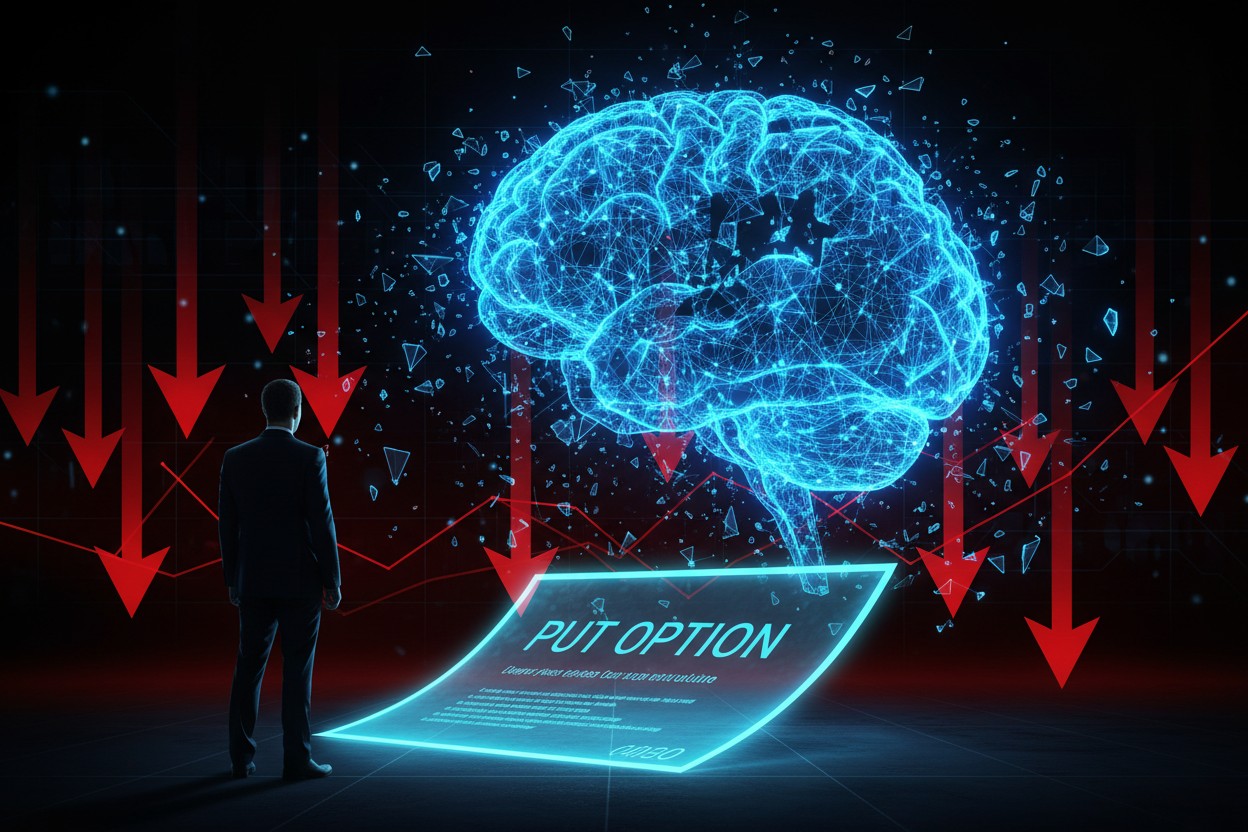
Investor Michael Burry said in a Sept. 28 investment newsletter that he is moving up the timeline for his bearish positions against key artificial intelligence (AI) stocks and switching from short sales to put options, according to CNBC.
Burry, who gained prominence for his bets against the U.S. housing market before the 2007–2009 financial crisis, wrote that new research led him to conclude that “the bubble in AI may burst sooner than later,” the report stated [1]. The investor said the change to put options gives him more cost-effective leverage over a shorter time horizon.
“Fundamentally, I am moving timelines up,” Burry wrote in the newsletter, according to CNBC. “As such, I want more leverage in my short positions. Better timelines make leverage more palatable. Nothing says leverage like options, in this case put options, which are relatively cheap due to exceptionally tight volatility measures such as the VIX” [1].
Burry said some of the moves were intended to reduce his tax liability, but that most were driven by his view on the timing of an AI bubble. The repositioning suggests the AI trade could flip by next summer, according to the report [2]. Long-standing critics of the AI buildout have argued that the sector rests on speculative projections and cheap debt rather than real revenue, a view that has circulated across independent financial commentary for months [3][4].
Burry Replaces AI Short Positions With Put Options
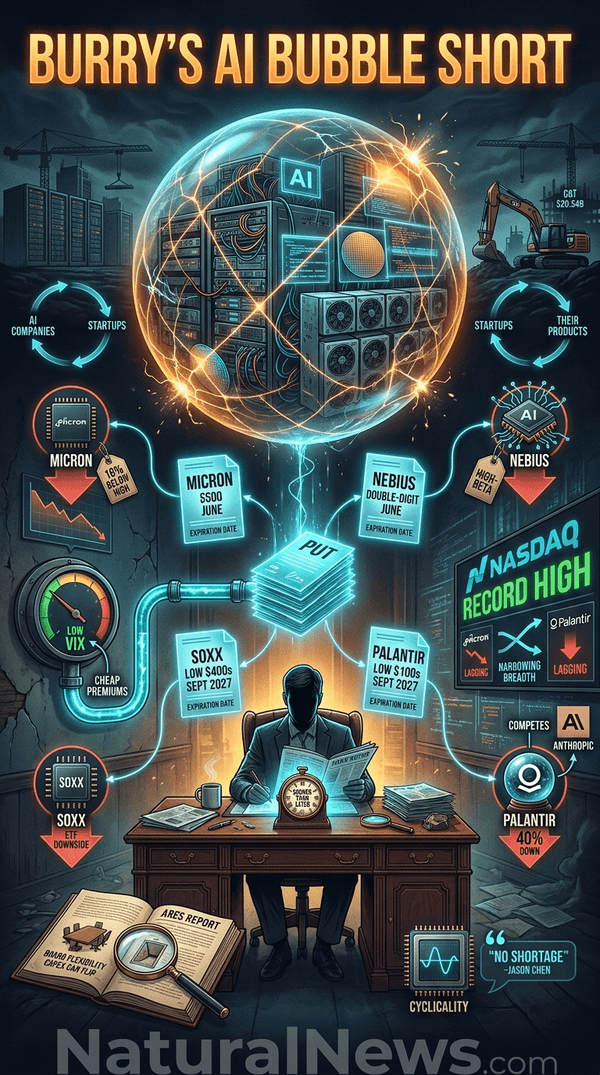
Burry said he swapped his Micron short with puts at a June expiration in a $500 strike price range, according to the newsletter. He replaced his Nebius short with puts at the June expiration in a double-digit strike price range, the report stated. He also replaced his SOXX iShares Semiconductor ETF short position with September 2027 puts in the low $400s [1].
The investor said he “replaced and rolled the Palantir short and put position into an enlarged put position” centered at a September 2027 expiration in the low $100s, according to CNBC. Palantir has drawn repeated scrutiny from Burry, who has publicly questioned the company’s valuation and claimed that AI startup Anthropic is effectively competing with its business model, the report stated [5].
Burry’s previous positions were conventional short sales, which carry theoretically unlimited loss potential if a stock keeps rising. Put options, by contrast, cap the buyer’s loss at the premium paid while still delivering leveraged downside exposure.
Burry said the shift was mostly because he thinks “the bubble in AI may burst sooner than later,” according to the newsletter [1]. The Nasdaq Composite closed at a record the prior week, even as several individual AI-linked names remained below their highs, the report stated [1].
Ares Report Cited on AI Capital Spending Assumption
Burry cited recent research from Ares Management that emphasized reliance on unproven revenues in the AI space, structured with demanding legal agreements, according to the newsletter. The Ares report said the AI boom is relying on an assumption of “sustained AI capital spending,” the report stated [1].
The Ares report said it would take only a season in which AI revenue disappoints the capital expenditure underwriting it. “In that scenario, a handful of boards, predisposed to redeploy capital toward the highest-conviction bet, would simply need to conclude that the highest-conviction bet has shifted. The legal documents contemplate that decision,” the Ares report says, according to the newsletter [1].
Broader skepticism about the sustainability of the AI capital spending cycle has surfaced repeatedly in independent financial commentary, with critics pointing to circular financing arrangements and rising debt loads tied to data center construction [6][7]. Companies and utilities have continued to expand capacity, however. Caterpillar reported second-quarter revenue of $20.54 billion, up 24% from a year earlier, driven in part by the data center buildout, according to ZeroHedge [8].
Acer CEO Comments on Memory Chip Cyclicality
Burry also cited Acer CEO Jason Chen, who told a Taiwanese media outlet that cyclicality was due to return to the memory chip sector. Chen was quoted as saying China’s production capacity has been consistently increasing and there is no shortage issue, according to the quote cited by Burry [1]. Chen said contract prices are currently fluctuating at a high level, with some prices going up and others down, according to the quote cited by Burry.
“How could there be a continuous shortage? China’s production capacity has been consistently increasing, and there is absolutely no shortage issue. Contract prices are currently fluctuating at a high level, with some prices going up and others down,” Chen was quoted as saying [1].
The comments bear on Micron, the U.S. memory manufacturer that Burry is now betting against through June puts. Reports have indicated that China’s largest memory company, CXMT, is testing a pilot production line for next-generation bonded DRAM in Hefei, aiming to achieve high-performance memory without advanced EUV lithography, according to ZeroHedge [9]. The trend of expanding Chinese capacity forms part of the cyclical backdrop Chen described [9].
References
- CNBC. “Michael Burry believes the AI bubble ‘may burst’ sooner than he first believed”. CNBC. September 28, 2026.
- Lance Roberts. “AI Bear Case: What Skeptics Get Right And Wrong”. ZeroHedge. July 31, 2026.
- NaturalNews.com. “Why I Can’t Wait for the AI Bubble to Crash”. NaturalNews.com. June 8, 2026.
- NaturalNews.com. “AI Bubble Alert: Why Nvidia and the Data Center Buildout Are Headed for a Historic Financial Crash”. NaturalNews.com. June 1, 2026.
- ZeroHedge. “Trump Touts Palantir In Post, Appearing To Counter Bears”. ZeroHedge. April 10, 2026.
- NTD. “Global AI Stocks Fall as Industry Chiefs Call for Slowing Development”. NTD. September 14, 2026.
- QTR’s Fringe Finance. “The AI Trade: Now With Less Circle And More Jerk”. ZeroHedge. March 7, 2026.
- ZeroHedge. “Caterpillar Erupts As Quarterly Sales Top $20 Billion For First Time Amid AI Data Center Boom”. ZeroHedge. August 4, 2026.
- ZeroHedge. “China CXMT Testing Production Line for Next-Gen Bonded DRAM, Closing Tech Gap With Korea ‘Far Faster Than Expected'”. ZeroHedge. July 6, 2026.
- NaturalNews.com. “The Big Short investor warns about mother of all crashes for crypto and meme stocks”. NaturalNews.com. June 23, 2021.
- NaturalNews.com. “SEC now silencing people who criticize overvalued market bubbles on social media”. NaturalNews.com. March 24, 2021.
- The Telegraph. “‘We are not Enron’: Nvidia rejects AI bubble fears”. The Telegraph. November 25, 2025.
- Lance Roberts. “AI Bears: Right About The Excess, May Be Wrong On The Trade”. ZeroHedge. September 5, 2026.
- ZeroHedge. “8 Market Bear Cases You Must Read Today”. ZeroHedge. August 26, 2026.
Explainer Infographic
Submit a correction >>
Tagged Under:
AI, AI bubble, Big Tech, Bubble, capital spending, computing, data center, debt bomb, debt collapse, Glitch, information technology, investing, market crash, Michael Burry, power grid, risk, stocks, tech giants, technology
This article may contain statements that reflect the opinion of the author
RECENT NEWS & ARTICLES